



Jean Jacque Rwomushana | Kampala | April 26, 2026
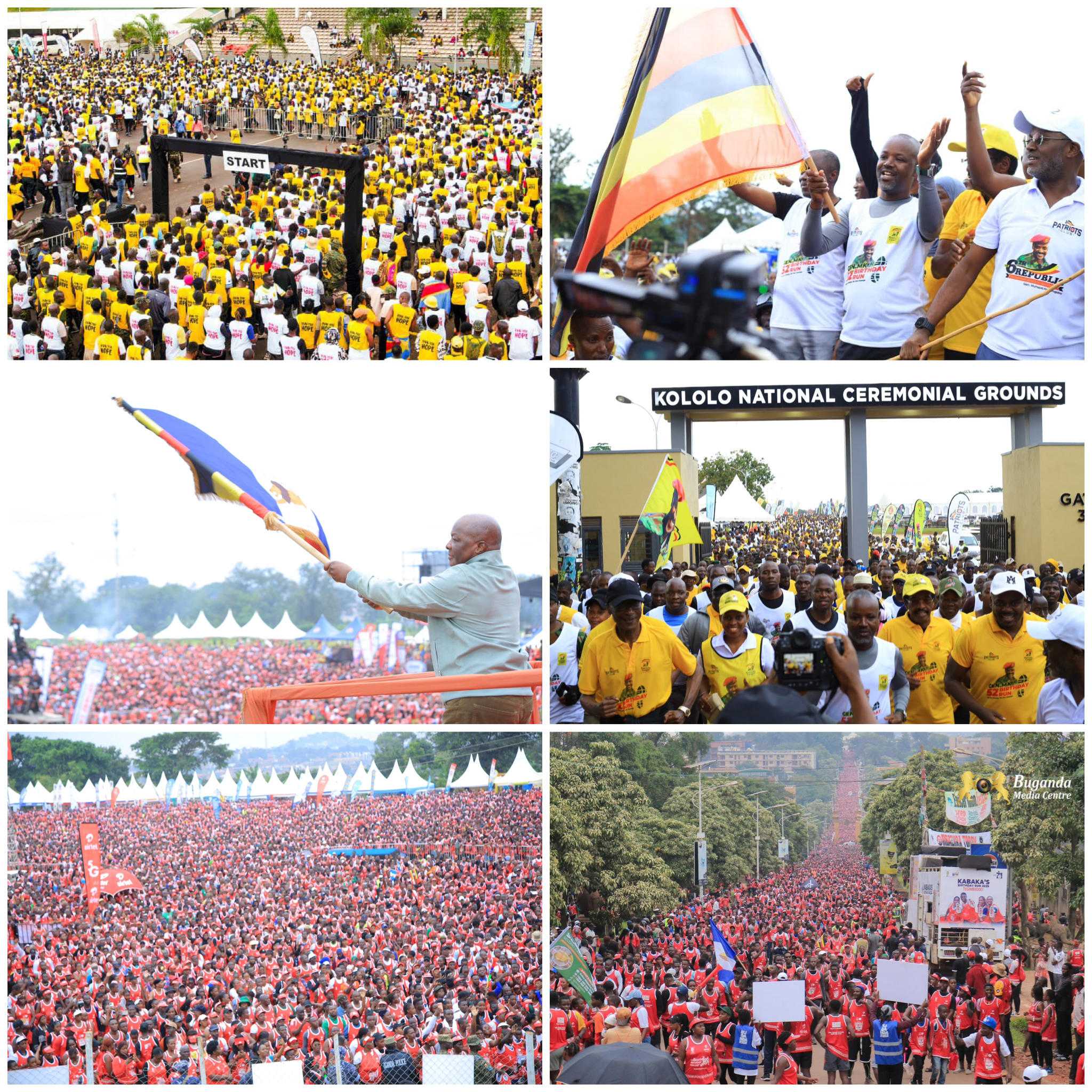
In Uganda’s charged political theatre, The Kabaka Birthday Run delivers an apolitical crowd size, energy, and symbolism with immeasurable influence, loyalty, and power for a cultural triumph. Gen. Muhoozi Kainerugaba’s 52nd Birthday Run at Kololo is posited as an antidote and as a direct counter-punch to deliberately eclipse the Kabaka’s turnout while subtly signaling a push number transition to his father Museveni’s presumed swearing-in for a seventh term on May 12, 2026.
This much-hyped showdown is already on course to end in failure — a “failed number battle” that exposes the limits of manufactured momentum against deep-rooted cultural resonance.Kabaka’s Record Cultural Triumph, The 13th Kabaka Birthday Run at Lubiri Palace in Mengo on April 12, 2026, celebrating Kabaka Ronald Muwenda Mutebi II’s 71st birthday, was nothing short of historic with projected 130,000 participants, and a massive, organic turnout that painted Kampala’s streets red with runners from across Uganda and the diaspora.
The event — themed around men’s health, protecting the girl child, and ending HIV/AIDS by 2030 — raised substantial funds through kits sold at Shs 25,000 each. It was a voluntary, grassroots spectacle: no state coercion, just genuine cultural loyalty that filled Lubiri grounds from 6am and drew loud cheers when the Kabaka flagged it off. It set an impossibly high bar for any follow-up “number” event.
MUHOOZI RUN: THE CALCULATED NUMBER FIGHT TO ECLIPSE AND SIGNAL TRANSITION
The Birthday Run at Kololo Independence Grounds is no innocent charity stroll barring the “Run for Charity, Run for Hope” — a fundraiser for babies’ homes, orphans, and child welfare. The organizers’ motive as a deliberate response to the Kabaka’s success has pushed for heavy promotion by security agencies, NRM figures, and state-aligned networks. Supporters and organizers have made no secret of the ambition: this is a number fight from the timing the just two weeks after Lubiri for a date known well before hand, the choice of Kololo (a venue tied to state power), and the institutional backing are designed to project Muhoozi’s personal and military clout.
More crucially, the run is being used to send a subtle but unmistakable message about leadership transition. After publicly endorsing his father for the 2026 elections, Muhoozi is leveraging the platform to blend charity, youth mobilization, and visibility — positioning himself as the bridge to the next era while affirming unwavering loyalty to President Museveni. Slogans of national unity and “One Uganda” reinforce the narrative of continuity under the Museveni family dynasty.
Ultimately, this is not just a birthday run, It is a high-stakes bid to outrun the Kabaka’s numbers, claim superior institutional muscle, and telegraph that the transition torch is already being passed — right in the heart of Kampala.
MUSEVENI’S SWEARING-IN: THE STATE’S FINAL WORD
On May 12, 2026, President Museveni will be sworn in at Kololo Ceremonial Grounds for another term. This state-orchestrated spectacle — complete with dignitaries, heavy security, and mobilised crowds — will showcase the full machinery of government. Unlike the voluntary runs, it is not a test of raw popularity but a display of entrenched power. It will serve as the official capstone to the “number battle,” projecting stability and continuity.
Interestingly, Museveni is not ready for perceived Transition and repeatedly demonstrated that he remains firmly in control and shows no public indication of fast-tracking any succession plan. In Uganda’s political reality, premature or overly visible signals of transition — especially when tied to large-scale public mobilization and family dynamics can easily be interpreted as disloyalty, over-ambition, or an attempt to force the president’s hand. History is littered with examples where individuals or groups perceived as accelerating timelines or building parallel power bases have found themselves sidelined, isolated, or turned into political prey. The very “number fight” and transition signaling embedded in Muhoozi’s run risk crossing that delicate line, potentially inviting scrutiny, internal adjustments, or even quiet countermeasures from the centre of power.
WHY MUHOOZI’S NUMBER FIGHT WAS DESTINED TO FAIL IN ITS TRACKS
Despite the deliberate strategy, the Muhoozi run was destined to fall short. The Kabaka’s event was organic, culturally anchored, and driven by deep Buganda loyalty that no amount of state or PLU mobilisation can fully replicate. Muhoozi’s effort, while it will undoubtedly draw solid numbers from his dedicated base and institutional allies, carries the unmistakable flavour of top-down orchestration. The attempt to eclipse the Kabaka’s significance and use the run as a transition signal will generate headlines and fundraising, but it cannot manufacture the same spontaneous, record-shattering resonance. Cultural pull simply outmatches calculated political optics in this arena. The “number battle” — Kabaka’s genuine thousands versus Muhoozi’s institutional push — will end not with a decisive victory for the latter, but with a clear demonstration of its limits.
As Uganda heads into the new presidential term, this April–May sequence reveals a deeper truth: in a society where culture, family, military, and state power intersect, raw “numbers” alone do not decide influence. The scoreboard was already clear before the starting gun: a failed number battle, where the real winner was never in doubt. Uganda keeps running — but some races are simply not meant to be overtaken.